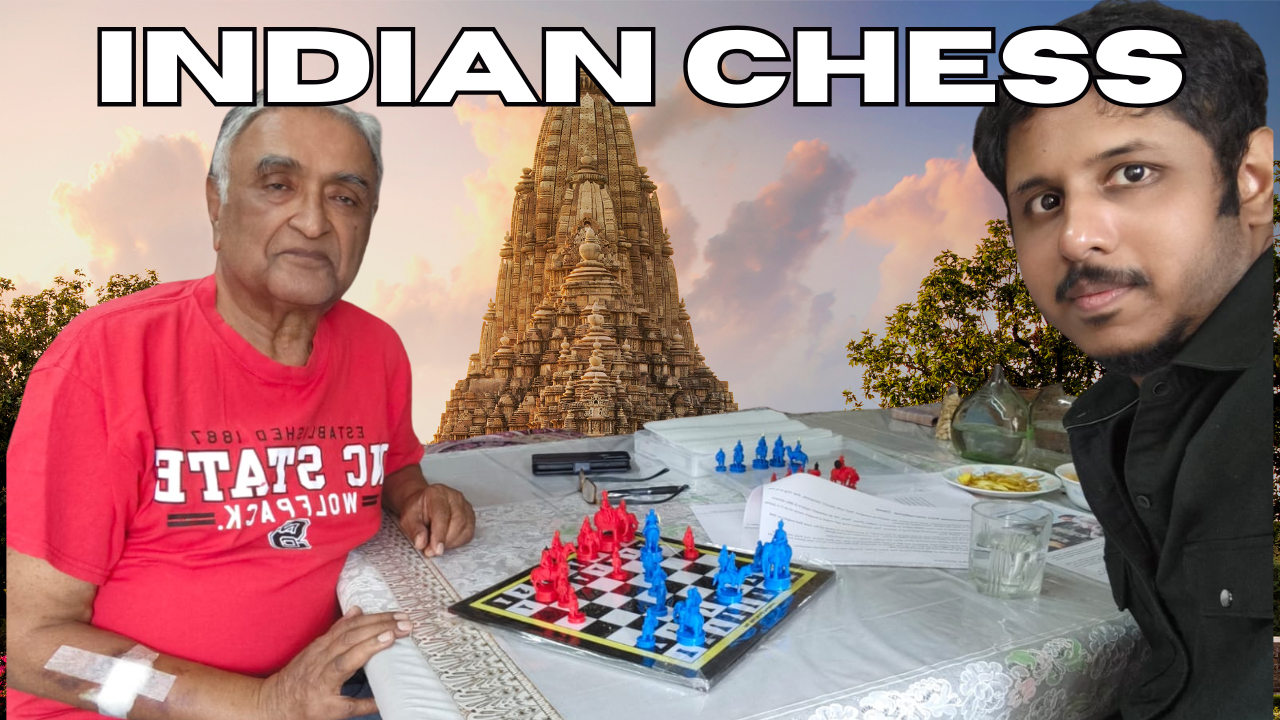
Summary: Indian Chess — rooted in the ancient game of Chaturanga — is the original form of chess as it was played on the Indian subcontinent for over 1,500 years. While modern international chess spread from India to Persia, Arabia, and Europe, India kept its own regional variants alive with different piece names, a slower pawn structure, a dramatic King's Leap, and rules that reflect the logic of real ancient armies. This article explains the history, piece names, and key rules of Indian Chess, and how EDUCHESS Trivandrum came to learn them firsthand.
What Is Indian Chess?
Chess born in India
Chess was invented in India around the 6th century CE during the Gupta Empire as a game called Chaturanga — meaning "four divisions of the military": elephants, chariots, cavalry, and infantry. These four wings of the ancient Indian army are still the four non-pawn pieces we play with today, simply renamed as the game travelled west.
From India, Chaturanga passed to Persia as Chatrang and then Shatranj, then to the Arab world, and finally to Europe where it evolved into the international game played in FIDE tournaments today. But in India itself, regional versions of the game — collectively called Indian Chess — continued to be played in Bengal, the South, and the Hindi heartland well into the 18th, 19th, and 20th centuries.
Why the name "checkmate"?
The word checkmate comes from the Persian phrase Shah Mat, meaning "the king is helpless." Shah is also the root of the English word "chess" — a direct reminder that the game's naming journey passed through Persia on its way from India to the rest of the world.
The Pieces — Indian Names vs International Names
Soldiers, ministers and war elephants
Instead of queens and bishops, Indian Chess uses piece names drawn from royal courts and ancient armies. The table below shows how each piece maps between the international and Indian (Hindi) traditions:
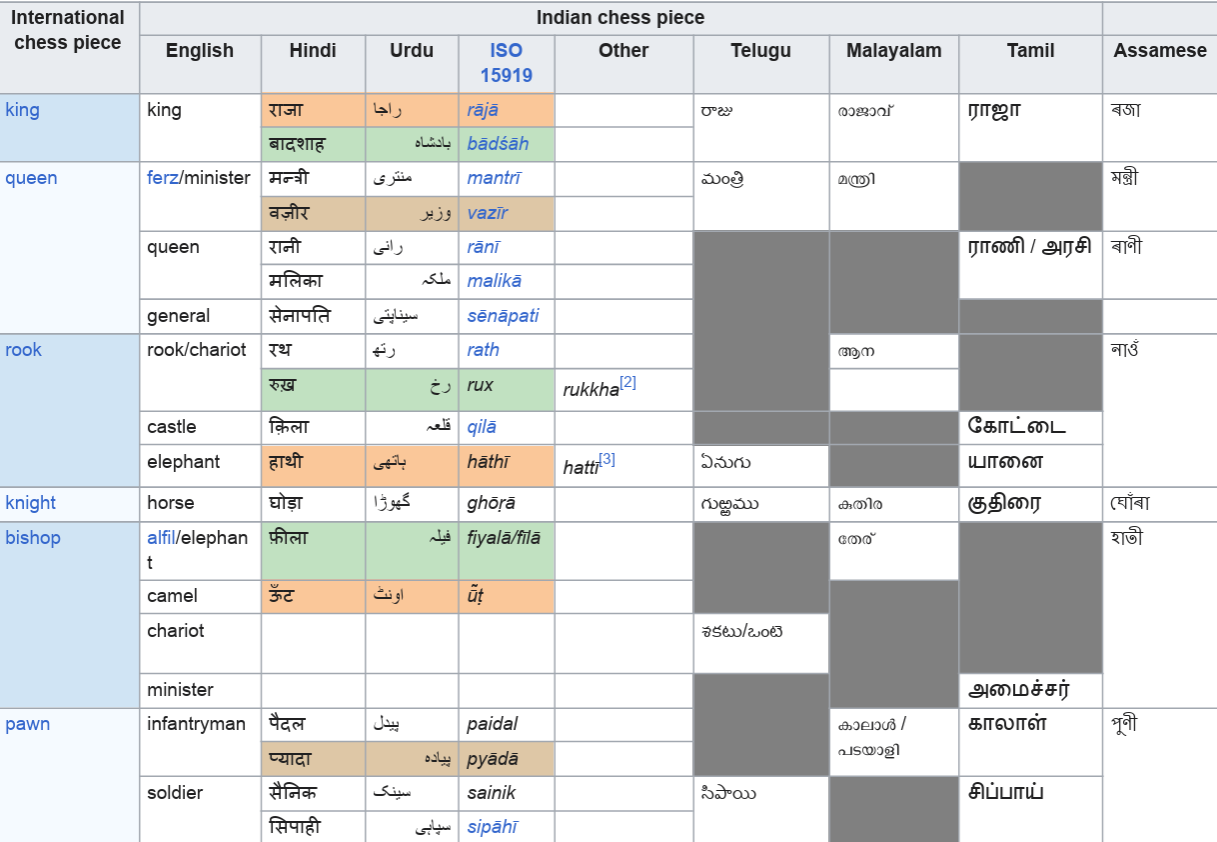
Piece names also exist in Telugu, Malayalam, Tamil, Urdu, and Assamese — showing that Indian Chess was not a game of one region or one language, but a truly national heritage with a different flavour in every part of the country. The term Senapati (सेनापति), meaning "general," is used in some regional versions as the name for the most powerful piece.
How Indian Chess Rules Differ from Modern Chess
No two-step pawn move
In modern chess, a pawn may advance two squares on its first move. In Indian Chess, this rule does not exist — every foot soldier (pawn) moves exactly one square forward every turn, no exceptions. This slows the opening, makes pawn structures denser, and demands more patient, strategic play from the very first move. Because there is no two-step move, the special capture known as en passant also does not apply.
No castling — but the King's Leap
Indian Chess has no castling. Instead, once per game, if the king has not yet been placed in check, he may make a knight's move — jumping exactly like a Ghoda (horse). This single dramatic leap, known as the King's Leap, can be used to escape danger or seize a tactical advantage. It reflects the Indian tradition of the king as a warrior who leads from the front: one bold jump per reign, use it wisely.
The king always faces the opposing minister
In the Indian Chess starting position, each king is set up so that it directly faces the enemy Mantri (minister/queen) across the board — regardless of which colour is playing. This is the opposite of the modern rule where the queen always begins on her own colour.
Pawn promotion follows the board's history
When a foot soldier reaches the far end of the board, it does not automatically become a queen as in modern chess. Instead, it becomes whatever piece originally stood on that square in the starting position. A pawn promoting on the square where the enemy king started becomes a Senapati (general/queen) — a rule that ties promotion to the living memory of the board.
The last piece is protected
If one side is reduced to just a single piece besides the king, that final piece cannot be captured. It is treated as a protected last survivor of the army, adding a layer of endgame strategy and a sense of mercy built into the rules.
Regional variations
Different parts of India added their own rules on top of the core. In some regions, the king could not move at all until the first check had been given in the game — forcing both players into aggressive attacking play before either king could escape. In pawn-only endgames, some variants forbade giving check while permitting stalemate as a winning condition, making even the final few pieces a rich tactical puzzle.
Where We Learned All This: Meeting CDR Joseph Thomas
We met CDR Joseph Thomas — a retired Commander of the Indian Navy and founder of Nubra Education & Research Pvt Ltd — through a WhatsApp chess group. On Sunday, 26 May 2026, he sat with us and walked through every rule of Indian Chess patiently, one by one, on an actual Indian chess set.
We played two full games, feeling the difference of every rule in real time — the absent two-step pawn, the tension of saving the King's Leap, the logic of piece-specific promotion. By the second game, the ancient rules were starting to feel entirely natural. At the end of the afternoon, CDR Thomas gifted us an Indian chess set — a collector's item that carries centuries of Indian heritage in its carved pieces. It was one of the most memorable chess afternoons EDUCHESS has had.
Why Indian Chess Still Matters
A living link to the game's origins
Modern chess is played identically across every country — which is great for global competition, but it has cost us much of the local colour and cultural depth that once made chess so rich. Indian Chess is a direct connection to that depth. When you call the queen a Mantri, you speak the language of the ancient courts. When a foot soldier promotes on the king's square and becomes a Senapati, you are playing a rule designed to mirror how real kingdoms worked.
Chess is India's gift to the world
Every chess player on the planet — from Russia to Argentina to Japan — is playing a game that was born in India. Indian Chess lets you play the form closest to the original, with piece names and rules that the inventors themselves would recognise. Learning Indian Chess is not simply learning a game variant; it is understanding where chess came from — and that it came from us.
FAQ: Indian Chess
What is the original name of Indian Chess?
The earliest form is called Chaturanga, meaning "four divisions." It was played in northern India during the Gupta Empire around the 6th century CE and is the direct ancestor of all chess variants played worldwide today.
What are the biggest rule differences from modern chess?
The main differences are: no two-step pawn move (and therefore no en passant), no castling (replaced by the one-time King's Leap), pawn promotion to the piece that originally stood on that square rather than free choice, and protection of the last remaining piece from capture.
Can I still play Indian Chess today?
Yes. Indian Chess sets are available through EDUCHESS Trivandrum (see below), and the rules can be learned in a single session. It is an excellent complement to modern chess training — especially for understanding pawn structures, endgame patience, and king safety in a fresh way.
What languages have names for the Indian chess pieces?
Piece names exist in Hindi, Urdu, Telugu, Malayalam, Tamil, Assamese, and other Indian languages — reflecting how deeply chess was woven into every region's culture long before the modern international game standardised all terminology in English.
♞ Own a Piece of History
The Indian Chess Set — a genuine collector's item — is now available through EDUCHESS Trivandrum. Handcrafted pieces with traditional Indian names. Perfect for chess lovers, history enthusiasts, and anyone who wants to connect with India's greatest cultural export.
Limited availability | Collector's Item | Makes a wonderful gift
To order or enquire, tap the button below to reach us directly on WhatsApp:
💬 Chat with EDUCHESS on WhatsAppEDUCHESS Trivandrum | Kerala, India | +91 96338 96415
