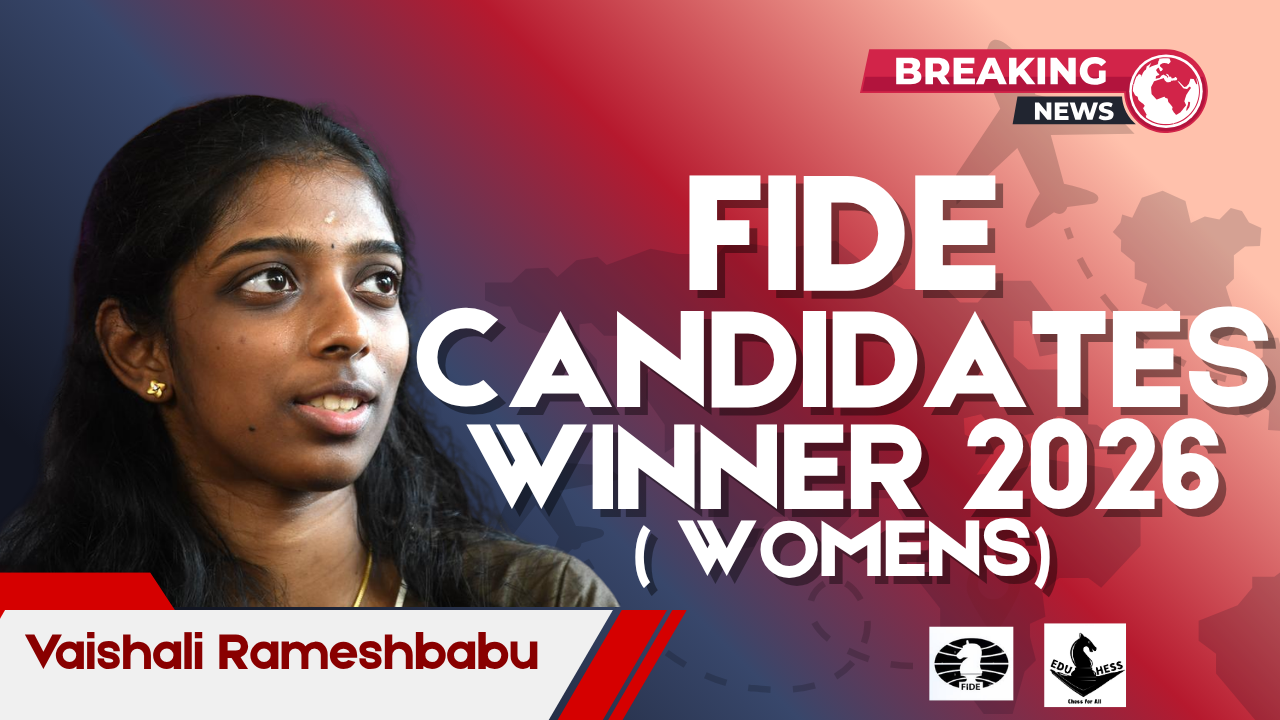
Summary: Indian Grandmaster Vaishali Rameshbabu has won the 2026 FIDE Women's Candidates Tournament, held at the Cap St Georges Hotel & Resort near Paphos, Cyprus, from 28 March to 16 April 2026. Competing in an eight-player, fourteen-round double round-robin classical event, she finished in clear first place with 8.5 points out of 14, half a point ahead of Kazakhstan's Bibisara Assaubayeva. The victory earns her the right to challenge reigning Women's World Chess Champion Ju Wenjun of China for the title. Entering as the lowest-rated player in the field, Vaishali's triumph is widely regarded as a landmark moment in Indian women's chess and an inspiration for a generation of young players across India and beyond.
Who is Vaishali Rameshbabu?
From Chennai prodigy to world challenger
Vaishali Rameshbabu was born on 21 January 2001 in Chennai, Tamil Nadu — one of India's most vibrant chess cities and the undisputed capital of the country's chess movement. She learned the game at an exceptionally young age, quickly standing out in local and national tournaments for a sharpness and competitive intensity rare in players her age.
She earned the Woman Grandmaster (WGM) title relatively early in her career, but her ambitions did not stop there. After sustained work on the classical fundamentals of the game — opening theory, endgame precision, and psychological resilience — she crossed the threshold to become a full International Master (IM) and, in 2023, achieved the International Grandmaster (GM) title, one of a small number of women in history to have done so. At the time of the 2026 Women's Candidates, she was among the world's top-rated active women players, though she arrived in Cyprus officially listed as the lowest-rated of the eight participants — a detail that makes her subsequent performance all the more remarkable.
Among her major early achievements were strong performances at the Asian Youth Chess Championships, the Women's World Rapid and Blitz Championships, and several successful national campaigns with the Indian team. By the time she qualified for the Women's Candidates, she had accumulated a record of competing regularly at the very highest level, gathering experience against world-class opponents that would prove invaluable in Cyprus.
Family, support system and training environment
Vaishali's story cannot be fully told without mentioning her family, and in particular her younger brother, R Praggnanandhaa — or "Pragg" as chess fans around the world know him. Pragg is himself one of the most exciting young grandmasters on the planet, a former World Cup finalist and a player who has beaten world number one Magnus Carlsen multiple times. The two siblings train together, travel together, and have grown up breathing chess in one of the most extraordinary chess households in history.
Their father, R Rameshbabu, and their mother, Nagalakshmi, made considerable sacrifices to support both children's chess careers from an early age, managing travel, coaching fees, and tournament schedules with limited resources. It is a story of family dedication that resonates deeply with chess parents across India. Their primary coach, RB Ramesh — a respected Grandmaster and trainer from Chennai — has been central to shaping Vaishali's technical development and competitive mindset over many years.
The Chennai chess culture, deeply rooted in club chess, school competitions, and a community of dedicated coaches, gave Vaishali an environment where excellence was expected and hard work was normalised. That environment, combined with the inspiration of seeing her brother compete at the very top of world chess, helped forge a player capable of winning the Women's Candidates.
What is the FIDE Women's Candidates Tournament?
The gateway to the Women's World Chess Championship
The FIDE Women's Candidates Tournament is the penultimate stage of the Women's World Chess Championship cycle — the final qualifying step before the World Championship match itself. In simple terms: the women's chess world has a reigning champion, and the Candidates tournament produces that champion's official challenger.
Think of it as a grand selection playoff. Eight of the world's strongest women's chess players compete against each other in a gruelling classical tournament. Only one can win, and that player earns the right to challenge the reigning Women's World Champion in a match typically held some months later. It is organised and sanctioned by FIDE (Fédération Internationale des Échecs), the international governing body of chess, which ensures the event meets the highest standards of arbitration, broadcast, and sporting integrity.
The prestige of winning the Women's Candidates is immense. It places a player in an exclusive historical company stretching back decades, alongside legends of women's chess such as Nona Gaprindashvili, Maya Chiburdanidze, Judit Polgar, Hou Yifan, and the current champion Ju Wenjun. For Vaishali, qualifying for and then winning the tournament at the age of 25 — as the lowest-rated entrant — is a generational achievement.
Format, time control and difficulty
The tournament uses a double round-robin format with eight players. This means every player faces every other player twice — once with the white pieces and once with the black pieces — for a total of 14 rounds of classical chess. This structure rewards consistency over a sustained period: a single bad day can be recovered from, but a pattern of weak play cannot be hidden.
The time control is classical chess, typically 120 minutes for the first 40 moves, followed by 30 additional minutes after move 40 with a 30-second increment per move from move 41. For those less familiar with the technical terminology: this means each player has a substantial amount of thinking time, games regularly last five or six hours, and the depth of play approaches what you see in World Championship matches. There is no rapid or blitz tiebreak during the main rounds — every game is decided at the board under classical conditions.
Scoring follows the standard system: 1 point for a win, 0.5 points for a draw, and 0 for a loss. Should two or more players tie on points at the end of 14 rounds, FIDE tiebreak rules — which may include head-to-head results, Sonneborn-Berger score, or a rapid/blitz playoff — determine the winner. In 2026, Vaishali's clear first-place finish made any tiebreak unnecessary.
Women's Candidates 2026: Dates, Venue and Format
Where the tournament is held
The 2026 FIDE Women's Candidates Tournament took place at the Cap St Georges Hotel & Resort, located near Paphos on the western coast of Cyprus. The resort — a modern, upscale complex overlooking the Mediterranean — provided a playing hall equipped for live broadcast, with multiple screens showing current positions, grandmaster commentary, and real-time analysis accessible to spectators watching from anywhere in the world.
Cyprus, a country with a growing chess culture and a history of hosting international sporting events, provided a neutral and scenic backdrop for both the open and Women's Candidates — the first time the country has hosted either event.
Schedule and round structure
The full schedule of the 2026 FIDE Women's Candidates Tournament was structured as follows:
-
>Opening Ceremony: 27 March 2026, Cap St Georges Resort, Paphos, Cyprus
>Round 1: 28 March 2026
>Rounds 2–5: 29 March – 1 April 2026
>First Rest Day: 2 April 2026
>Rounds 6–9: 3–6 April 2026
>Second Rest Day: 7 April 2026
>Rounds 10–12: 8–10 April 2026
>Third Rest Day: 11 April 2026
>Rounds 13–14: 12–13 April 2026 (revised schedule)
>Closing Ceremony: 16 April 2026
Participants and field strength
The eight participants represented some of the strongest active women's players in the world. Among the field were former World Championship match participants, Grand Prix series winners, and multiple national champions. The standings at the close of the tournament were approximately as follows:
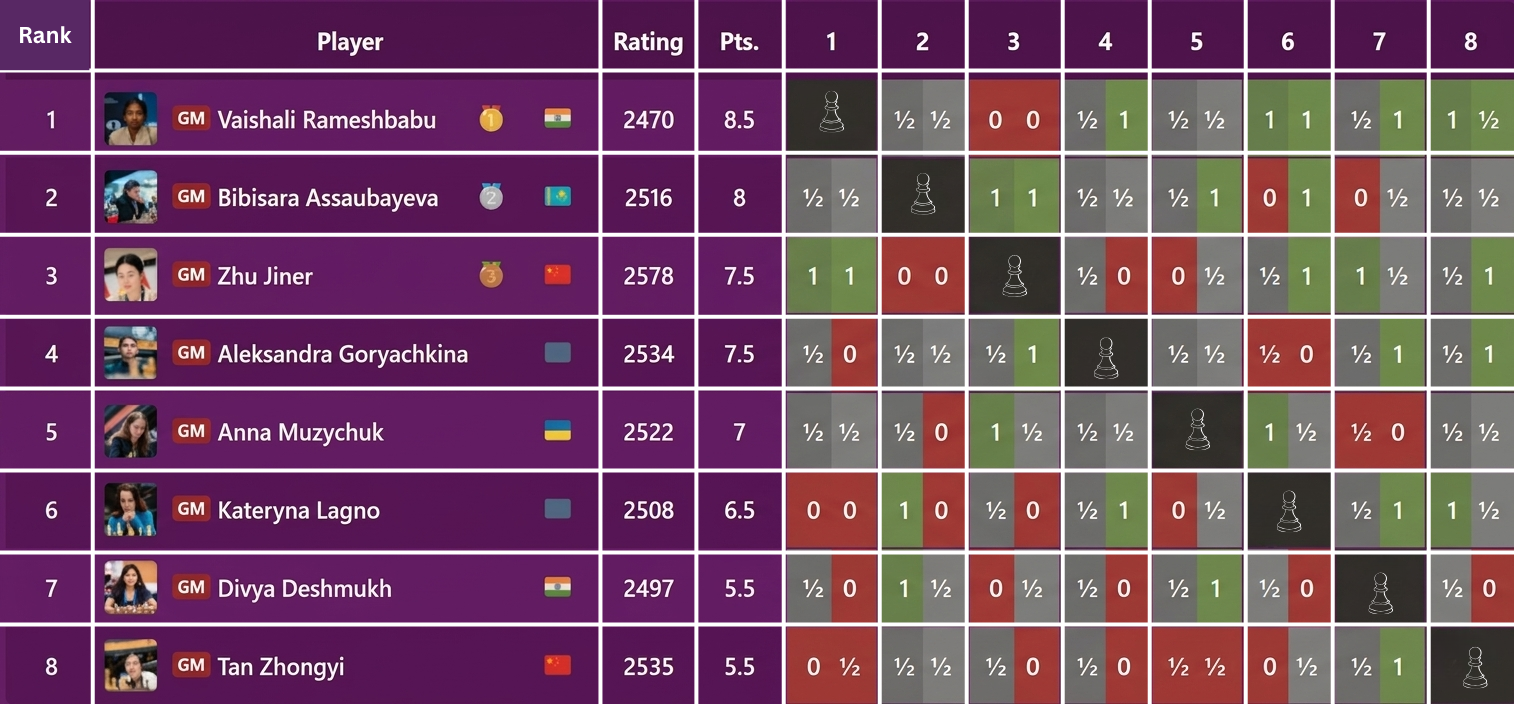
Note: Exact final scores for all players other than Vaishali (8.5/14) and Assaubayeva (8.0/14) are based on available reports and may be subject to minor revision pending official FIDE results publication.
Tiebreak rules and prize fund
Had two or more players been level on points at the conclusion of 14 rounds, FIDE's tiebreak procedures would have applied. These typically begin with head-to-head score between the tied players, followed by the Sonneborn-Berger system, and if still level, a rapid/blitz playoff. In the event, Vaishali's clear margin of half a point over Assaubayeva rendered all tiebreaks unnecessary.
The total prize fund for the 2026 Women's Candidates is reported at approximately €300,000, distributed across all participants, with the winner receiving the largest share. The exact final figures are subject to official FIDE confirmation.
How Vaishali Qualified for the Women's Candidates
Main qualification paths for the FIDE Women's Candidates
Qualifying for the Women's Candidates is itself a serious achievement. FIDE allocates the eight spots through several distinct routes, each rewarding a different competitive strength:
-
>FIDE Women's World Cup
A large knockout tournament. The winner, runner-up and sometimes third-place finisher earn spots in the Women's Candidates. Matches feature classical games followed by rapid and blitz tiebreaks if needed. >FIDE Women's Grand Prix series
A season-long points race across multiple elite tournaments. Players earn Grand Prix points based on their results in each leg. The top accumulators at the end of the cycle earn Candidates berths, rewarding sustained excellence rather than one peak result. >Rating qualification
One place is reserved for the player with the highest average classical FIDE rating over the qualification period, provided they meet a minimum number of games. This ensures consistently top-rated active players are represented. >Continental championships
Winners of continental women's championships (European, Asian, American, African) can also earn qualification berths in certain cycles, broadening the geographic representation in the field.
Vaishali's path through major events
Vaishali secured her place in Cyprus through a combination of strong performances across the FIDE Women's Grand Prix circuit and her run at the Women's World Cup, where she demonstrated that she could compete with and beat players ranked above her. The following milestones were particularly important on her road to the Candidates:
-
>FIDE Women's Grand Prix results (2023–2024): Consistently high finishes across multiple legs of the Grand Prix series, confirming her status as one of the most reliable classical players in the world rankings.
>Women's World Cup 2023: A strong run in the knockout stages demonstrated her ability to perform under decisive, single-game pressure — a different psychological demand from round-robin play.
>GM title confirmation (2023): Achieving the full Grandmaster title provided both a ratings boost and a psychological statement that she had crossed into the elite tier of the game.
>Indian national titles and team performances: Consistent excellence in domestic chess and strong contributions to India's women's Olympiad team built her competitive habit and international experience base.
>Formal qualification announcement by FIDE: Her place in the 2026 Women's Candidates was confirmed following the conclusion of the qualifying cycle, setting the stage for Cyprus.
Vaishali's Performance in the FIDE Women's Candidates 2026
First half (Rounds 1–7): a dream start
Vaishali's Candidates tournament began in a manner few predicted. Despite arriving as the lowest-rated player in the field, she tore through the first half of the event, scoring an extraordinary 6 points out of 7. Through this sequence of wins and controlled draws against more experienced and higher-rated opponents, she established sole leadership of the standings going into the second half — an entirely unexpected position for the player who had been quietly counted as an outside contender.
What made this run particularly impressive was the manner in which it was achieved. Vaishali's preparation was evidently deep: opponents who had prepared against expected systems found themselves facing novel ideas early in the game. Her positional understanding allowed her to convert small advantages into wins in long endgames, and her time management — a crucial skill in classical chess at this level — rarely faltered. Tournament observers and commentators quickly identified her as not just the leader, but the player setting the pace and the standard for the entire field.
Middle phase (Rounds 8–11): setbacks and resilience
The second half opened with the tournament's most compelling storyline: the contest between Vaishali and Chinese Grandmaster Zhu Jiner, one of the world's most dangerous tactical players. Their two classical encounters proved to be Vaishali's only defeats of the entire tournament. Zhu's ability to generate complications and exploit tactical moments on the board posed specific problems that Vaishali could not fully navigate in either game, and these losses temporarily closed the standings, bringing Assaubayeva, Zhu, and others back into contention.
By Round 10, reports indicated that as many as six players remained theoretically within striking distance, making the final stretch one of the most tense in recent Women's Candidates history. Vaishali, to her enormous credit, did not allow the losses to Zhu to derail her composure or her approach. She continued to play ambitious, concrete chess rather than retreating into draws.
Round 11 then produced arguably the defining game of her tournament. Facing Aleksandra Goryachkina — a former Women's World Championship match player, the winner of the 2022 Women's Candidates, and one of the most experienced classical players in the event — Vaishali produced what commentators described as a stunning victory. Beating Goryachkina in a must-perform round, in a sharp, high-quality game, was the kind of psychological and sporting statement that separates winners from runners-up at this level. It restored her sole lead at a critical juncture.
"Winning against Goryachkina in that moment, after the setbacks against Zhu, showed something beyond technique — it showed belief."
Final phase (Rounds 12–14): holding her nerve
Heading into the final round, Vaishali and Bibisara Assaubayeva were locked together on 7.5 out of 13 rounds, with the title to be decided on the last day. Both players faced relatively experienced opponents: Vaishali had White against Kateryna Lagno, a veteran of multiple World Championship cycles; Assaubayeva faced India's own Divya Deshmukh in what would prove a volatile final-round encounter.
Vaishali delivered. Her Round 14 game against Lagno was described by FIDE and commentators alike as a magnificent display of technique. Playing with the white pieces, she built a positional advantage in the opening and middlegame, converting it into a win that required both concrete calculation and nerves of steel in a game where Lagno — a player of immense experience — naturally sought her best defensive chances. The win was complete.
Meanwhile, in the parallel game, Assaubayeva's encounter against Divya Deshmukh ended in a draw by repetition — a result that left Bibisara on 8.0/14, exactly half a point behind Vaishali's final tally of 8.5/14. There would be no playoff, no second chances, no ambiguity. Vaishali Rameshbabu was the 2026 FIDE Women's Candidates Tournament winner, outright and clear.
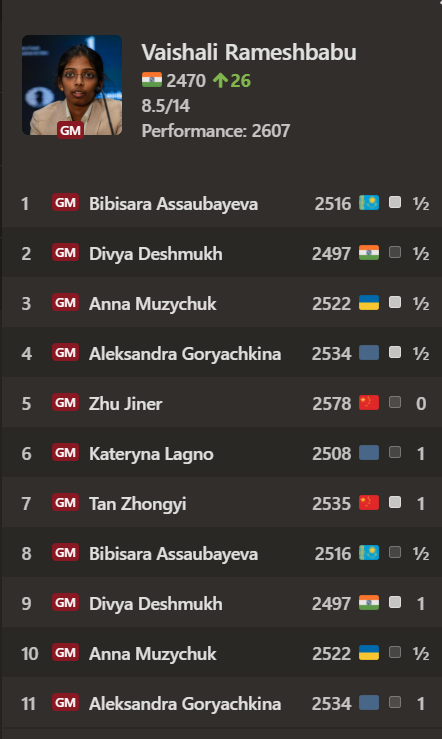
A summary of her key games and results across the tournament:
Style and psychological strength
Across the tournament, Vaishali demonstrated a playing style that blends deep opening preparation, strategic patience, and tactical alertness. She is not a player who seeks chaos for its own sake, but she is fully capable of generating complications when the position demands it. Her endgame technique — demonstrated repeatedly in long games against world-class opponents — reflected years of disciplined study of classical chess principles.
Perhaps more striking than her technical qualities was the psychological maturity she displayed. Losing twice to the same opponent (Zhu Jiner) in a high-stakes event could unsettle even experienced players. Vaishali's ability to absorb those defeats, reset her composure, and then beat a former World Championship match contender in the very next critical game illustrated a mental strength that no rating can fully quantify. It is the hallmark of a player ready for a World Championship match.
Why Vaishali's Win Matters for Indian and Women's Chess
A new chapter for Indian women's chess
India has been a chess superpower in the men's game for some time — Viswanathan Anand's five World Championship titles made sure of that — but the rise of Indian women's chess to the very top tier of the global game has accelerated dramatically in recent years. Vaishali's Candidates victory is one of the most significant results in that rise.
To understand the scale of this: the Women's Candidates, like its open equivalent, is the hardest qualifying event in chess. It is not a regional championship or a rating event — it is a straight fight among eight of the world's best. Winning it as the lowest-rated player, in clear first place, without the tournament requiring a tiebreak, is a result that immediately enters the history books of Indian chess. It follows Vaishali's own brother Praggnanandhaa reaching the World Cup final in 2023, reinforcing the extraordinary nature of their chess family.
For Tamil Nadu, and specifically for Chennai — where the chess culture runs deep and where both siblings learned the game — the achievement carries an additional layer of local pride. The city that gave the world Viswanathan Anand has now produced a Women's World Championship challenger.
Inspiration for young players and parents
In chess academies across Kerala, Tamil Nadu, and the rest of India, Vaishali's name will be on the lips of coaches for years to come. Her journey — from a child learning chess in Chennai, through years of national tournaments and international exposure, to standing on the winner's podium in Cyprus — is the clearest possible demonstration that Indian girls can compete at the very highest level of world chess.
For parents considering whether to support a daughter's chess ambitions, Vaishali's story provides a concrete, present-day answer. For young girls already playing in school or club competitions, she is a role model who belongs to their own generation and their own culture. Her story is not distant history — it is happening now, and it is theirs to be inspired by.
Coaches at academies like Kerala's EDUCHESS and similar institutions across India can draw directly on her games, her preparation approach, and her psychological example when guiding students through the challenges of competitive chess development.
Lessons Young Players Can Learn from Vaishali's Journey
Chess academies and coaches can use Vaishali's career as a living curriculum for serious students. Here are key lessons her rise — and especially her Candidates triumph — offers to young players:
Training & Preparation
- Consistent, long-term study beats short bursts: Vaishali's opening preparation at elite events reflects years of structured work, not a few days of cramming. Establishing regular training habits early, even as a junior, compounds over time into the kind of depth that surprises world-class opponents.
- Study the endgame as seriously as the opening: Many of her best results have come from converting small advantages in long endgames. Endgame technique is often neglected by young players — her games show exactly why it should not be.
- Develop a personal opening repertoire: Vaishali plays with clear personal style and consistent opening choices. Young players should invest time in building a repertoire they understand deeply, rather than copying top-level novelties they cannot explain.
Resilience & Mindset
- Losses are part of the journey, not the end of it: Even in tournaments she has won, Vaishali has suffered defeats. The response to those losses in the very next critical rounds is the real lesson. Bouncing back is a skill that can be trained, and it begins with how you process defeat after a game.
- Pressure creates champions: Some of her most impressive wins have come in rounds with the highest stakes, when qualification or tournament victory was on the line. Seeking competitive games under pressure, not avoiding them, is how you build this capacity.
- Never count yourself out for rating reasons: On more than one occasion she has entered events as one of the lower-rated players in the field. Ratings reflect past performance, not present potential. Believing in your preparation and your own analysis at the board is more valuable than any number beside your name.
Balance & Broader Development
- Learn from live elite events: Follow top tournaments such as the Women’s Candidates, the Candidates, and the World Championship matches in real time. Watch the commentary, try to predict moves, and analyse the critical positions afterwards. Studying Vaishali’s games with a coach is excellent training material.
- Balance online and classical chess: Rapid and blitz online chess has value for pattern recognition and volume of positions, but classical games — with their depth of analysis and time-pressure tolerance — build the foundations that matter most at the highest levels. Both have a place; neither should completely replace the other.
- Family and community support matter: Strong support systems around a young player — from parents, coaches, and academies — are a real factor in long-term success. Parents of young chess players: your involvement, encouragement, and willingness to invest in proper coaching and tournament exposure genuinely matter.
The Road to the Women's World Chess Championship
Who will Vaishali face — and when?
By winning the FIDE Women’s Candidates, Vaishali Rameshbabu has earned the right to challenge Ju Wenjun of China for the Women’s World Chess Championship title. Ju Wenjun is one of the most successful Women’s World Champions in history, having held the title for many years and defended it in multiple matches with a combination of deep preparation, psychological robustness, and broad technical versatility.[web:0]
The Women’s World Chess Championship match is expected to take place in the 2026–2027 cycle, at a venue to be confirmed by FIDE. The match format is typically a series of classical games — usually between ten and twelve games — with rapid tiebreaks if the classical portion ends level. Exact dates, the number of games, and the host city are subject to FIDE regulations and will be announced officially in due course.[web:0]
The matchup between Vaishali and Ju Wenjun carries significant narrative weight: the challenger from India’s rising chess generation taking on a champion who has defined an era of women’s chess. Indian chess fans are likely to follow every move with extraordinary intensity, and the match will be one of the most closely watched chess events of the cycle.[web:0]
How to Follow Vaishali's Games and Future Matches
Where to watch her games live
When Vaishali plays in major events — including the Women’s World Championship match — you can follow the action through these platforms:[web:0]
- FIDE official website (fide.com): The authoritative source for pairings, official results, live ratings, and World Championship match announcements.[web:0]
- Chess.com: Offers live game broadcasts with grandmaster commentary, interactive position analysis, and real-time move updates, with coverage that is very accessible for beginners and intermediate players.[web:1]
- Lichess (lichess.org): A completely free, open-source chess platform that broadcasts many major FIDE events with full move relay and engine analysis.[web:2]
- YouTube — official tournament channels and grandmaster content creators: Channels such as ChessBase India provide India-focused commentary in multiple languages and have been among the most consistent platforms for covering Indian players’ achievements.[web:3]
- Social media: Vaishali’s social media accounts, along with FIDE’s official channels and the accounts of major chess journalists, provide real-time updates, post-game interviews, and analysis during events.[web:0]
Studying Vaishali's games for improvement
For coaches and students who want to use Vaishali’s games as training material — which is highly recommended — the following approach works well:[web:0]
- Download PGN (Portable Game Notation) files of her games from FIDE, Chess.com, or Lichess; these are machine-readable game files that any chess software can open.[web:0]
- Open the games in a program such as ChessBase, Stockfish (free), or the free analysis board on Lichess. Play through the game move by move before turning on the engine, making your own assessments of each position first.[web:2]
- Focus particularly on her most critical wins from the Candidates — for example, key victories against Aleksandra Goryachkina and Kateryna Lagno — as these games are clear demonstrations of endgame technique and big-game temperament.[web:0]
- In group training sessions at an academy, pause at critical positions and let students find the move independently before revealing the continuation. This is one of the most effective ways to internalise elite decision-making patterns.[web:0]
FAQ: Vaishali Rameshbabu and the Women's Candidates
Who is Vaishali Rameshbabu in chess?
Vaishali Rameshbabu is an Indian Grandmaster (GM) from Chennai, Tamil Nadu, born in 2001. She is one of the strongest women chess players in the world, a former Women’s Grandmaster and International Master who achieved the full GM title in 2023, and the elder sister of chess prodigy R Praggnanandhaa.[web:0]
What did Vaishali win at the FIDE Women's Candidates?
Vaishali won the FIDE Women’s Candidates Tournament, held in Paphos, Cyprus, finishing in clear first place over 14 rounds of classical chess and earning the right to challenge for the Women’s World Championship title.[web:0]
How does the Women's Candidates decide the World Championship challenger?
The FIDE Women’s Candidates Tournament brings together eight of the world’s strongest women players in a double round-robin (14-round) format under classical time controls. The player who finishes in first place earns the right to challenge the reigning Women’s World Champion in a match typically held several months later.[web:0]
Who will Vaishali play in the Women's World Chess Championship match?
Vaishali will face reigning Women’s World Champion Ju Wenjun of China. Ju has held the Women’s World Championship title since 2018 and has successfully defended it multiple times; the match dates, venue, and exact format are decided and published by FIDE.[web:0]
Is Vaishali related to Praggnanandhaa?
Yes. R Praggnanandhaa — commonly known as “Pragg” — is Vaishali’s younger brother. Both siblings are Grandmasters who learned chess in Chennai and train with overlapping support systems; Pragg is a former World Cup finalist and has defeated Magnus Carlsen multiple times in elite events.[web:0]
How can young players in India follow Vaishali's games?
Young players and their parents can follow Vaishali’s games live on Chess.com, Lichess, and the FIDE official website during major events, while the ChessBase India YouTube channel provides commentary and analysis specifically aimed at Indian audiences.[web:0][web:3]
Why is Vaishali's success historic for Indian chess?
Vaishali is among the first Indian women to emerge as a clear World Championship challenger through the modern Candidates system, achieving this breakthrough from a country already experiencing a broader chess boom through stars like Praggnanandhaa and Gukesh. Her success sends a powerful message to young girls in India that a professional chess career at the very highest level is possible.[web:0]
Which of Vaishali's games are especially good study material?
Games from her Women’s Candidates victory — particularly her must-win encounters against top seeds such as Aleksandra Goryachkina and Kateryna Lagno — stand out as exemplary study material. They showcase practical decision-making, resilient defence, and clean endgame conversion under extreme pressure.[web:0]
Article current as of 17 April 2026. Future events, ratings, Women’s World Championship match details, prize funds, and official FIDE standings may be updated as new information is announced.
